Case study · Generative AI platform
AIClipForge — AI video creation platform
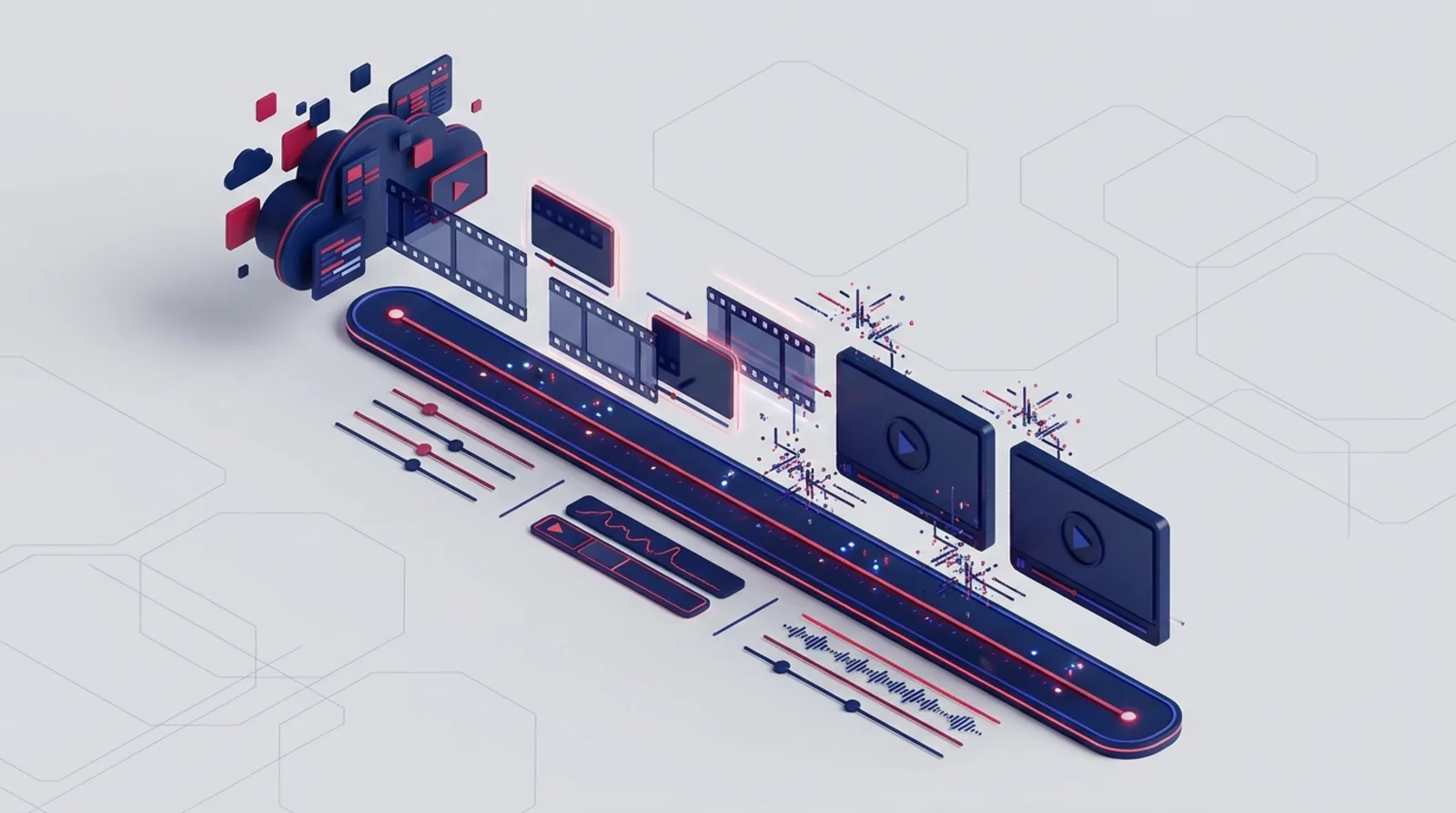
AI platform for generating and editing video clips, powered by a multi-model pipeline. SeedVision delivered architecture, AI pipeline, cloud deployment and observability.
Engagement period: · Page last reviewed on
Context
AIClipForge automates video clip creation via a multi-model orchestrator (text, voice, image, video, then mixing). The challenge: serve creative users with contained latency, despite high GPU costs.
Challenge
Design an AI pipeline composed of several chained models, horizontally able to scale, observable end to end, and economically viable despite the GPU cost of video models.
Approach
SeedVision architected an orchestration pipeline decoupling each step (queue, worker, model), with smart routing to the cheapest viable model, intermediate output caching, Langfuse and Grafana observability, and automatic fallback when a provider saturates.
Engagement timeline
- — Architecture and pipeline industrialisation. Design of the multi-model orchestrator, queue-based decoupling of the steps, Kubernetes deployment and per-generation cost observability.
- — Operations and cost arbitration. 2 years of operations: per-generation cost tracking, tuning of provider routing and regular verification of the automatic fallback when one of them saturates.
Before and after
Generation cost
Before: Without per-generation measurement, a GPU bill is read at the end of the month, when nothing can be corrected any more.
After: Real-time per-generation cost observability, and routing to the cheapest model capable of the task.
Load handling
Before: A synchronous chain blocks the user for the whole generation and collapses on the first spike.
After: Queue and asynchronous workers: the architecture absorbs spikes instead of passing them on.
Provider dependency
Before: A single model provider turns its outage into the platform's outage.
After: Automatic fallback to another provider on saturation, with no human intervention.
Diagnosis
Before: In a five-model chain without traces, nobody can tell which step produced a bad output.
After: End-to-end Langfuse and Grafana observability, step by step.
Results
- Multi-model pipeline industrialised on Kubernetes
- Real-time per-generation cost observability
- Smart multi-provider routing, with savings on the GPU bill
- Architecture ready to scale (queue and asynchronous workers)
Technologies and scope
- IA générative
- Pipeline
- Cloud
- MLOps
Engagement period:
What the engagement covers, block by block
- Multi-model orchestrator — Text, voice, image, video, then mixing. Each step sits behind a queue: it can be retried, replaced or duplicated without touching the others.
- Routing and caching — Selecting the cheapest model capable of the task and reusing already computed intermediate outputs: two cost levers that require no compromise on the delivered result.
- Kubernetes deployment — Asynchronous workers sized independently from the interface, so GPU capacity can be adjusted without redeploying the application.
- Observability and cost — Langfuse for quality and per-generation cost, Grafana for infrastructure health. Cost is a production metric, exactly like latency.
What running it demands
- A generative pipeline is watched on cost as much as on latency — A price drift raises no error: everything keeps working, simply more expensively. Without an alert on per-generation cost, the drift is discovered on the invoice.
- Provider saturation is a normal state, not an incident — Rented GPU capacity is shared. Automatic fallback is therefore treated as a nominal path, tested regularly, rather than an emergency procedure rarely taken.
- Intermediate caching belongs to the architecture — Added afterwards it becomes a brittle layer over steps that have nothing in common. Planned from the start, it makes every step replayable at no cost.
Architecture choices, and why
- Queue decoupling rather than chained calls — Five models called in cascade fail together and cannot resume. Separated by a queue, each failure becomes local and retryable, without regenerating everything.
- Several providers rather than one — The cost and availability of video models vary a lot. Being able to switch provider without redeploying is an architecture decision, not a last-minute setting.
- Cost treated as a production metric — Measuring per-generation cost in the same place as latency makes the quality-versus-price trade-off a matter of numbers rather than impressions.
Technical and regulatory milestones
Public, dated facts that constrain the scope.
- — The EU AI Act enters into force. A public calendar, quoted here because it constrains every generative platform served in Europe: the regulation entered into force on that date, with a staged application over two years.
- — Obligations for general-purpose AI models. Since that date, providers of general-purpose models carry their own obligations (technical documentation, information for integrators). A platform chaining several models must know which ones it calls, and record it.
- — General regime becomes applicable. The public deadline at which most of the regulation applies, including transparency duties on generated content. That deadline is why every output is traced back to the model that produced it, today rather than later.
Questions about this engagement
What happens when a model provider is saturated?
Nothing visible to the user as long as the failover works: provider saturation is treated as a normal state of the system, not as an incident. Because the steps are decoupled by a queue, generation resumes on another provider instead of failing.
How is the cost of a generation known?
It is measured per generation, exactly like latency: observability reports it in real time and routing sends each step to the cheapest model that holds the expected quality. Caching intermediate outputs avoids paying twice for the same step.
Can a model be replaced without rebuilding the pipeline?
Yes: each step — text, voice, image, video, mixing — is an independent worker behind a queue. Swapping the model of one step does not touch the others, which is precisely why the pipeline is decoupled.
Related services
- Agent & RAG POC — 10 to 15 days
- MLOps industrialisation — 15 to 30 days
Nearby case studies
- Business RAG agent — 2024 → present
- GreenCart — 2025 → present
Related reading on the blog
- Gemini 3.5 Flash: What Speed at Lower Cost Means for Production Agents
- A/B Testing Models in Production Beats Shadow Traffic Alone
- Kueue: why your Kubernetes job is still pending
- Mistral Medium 3.5 + Remote Agents: A New Open-Weight MLOps Stack
- AI Model Routing: 74% Cheaper, Six Accuracy Points Lost
- Quantization-Aware Healing: A 4-Bit Model That Beats FP16
- Agentic Search: Mistral Triples RAG Accuracy
Talk about your project
Facing a challenge close to AIClipForge — write to contact@seedvision.fr — reply within 24 hours.